
Siglent SDS7804A H12 Digital Oscilloscope, 4CH, 8GHz, 500Mpts, 12-Bit, SDS7000A Series
Our Part #20019618
Condition:New
Mfr Part #SDS7804A H12
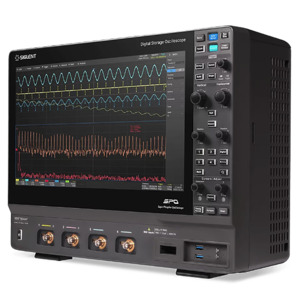
Siglent SDS7804A H12 Digital Oscilloscope, 4CH, 8GHz, 500Mpts, 12-Bit, SDS7000A Series
Our Part #20019618
Condition:New
Mfr Part #SDS7804A H12
- Description
- Specifications
- Documents
Siglent SDS7804A H12 Digital Oscilloscope
The Siglent SDS7804A H12 is a high-performance 4-channel digital storage oscilloscope designed for advanced signal analysis. It features an 8 GHz bandwidth, up to 20 GSa/s sampling rate on all channels, and an optional 2 Gpts per channel (SDS7000AP-2GPTS). With a 12-bit ADC, it delivers high-resolution waveform capture, supported by Siglent’s SPO technology for up to 1,000,000 waveforms per second. The SDS7804A H12 includes a 15.6" HD capacitive touchscreen, advanced triggering options, serial bus decoding, and optional features like eye/jitter analysis, and compliance testing, making it ideal for demanding R&D and compliance environments.
Key Features of SDS7804A H12
4 analog channels, 8 GHz bandwidth with up to 20GSa/s sample rate
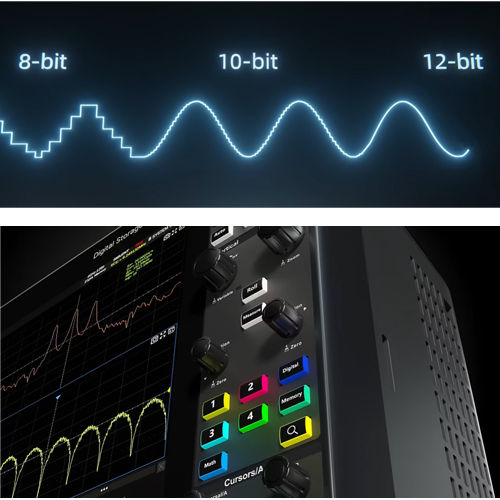
12-bit ADC shows you more details and less noise on the waveform
Low background noise: 300 μVrms at 8 GHz bandwidth, 220 μVrms at 4 GHz bandwidth
Super Phosphor Oscilloscope (SPO) technology
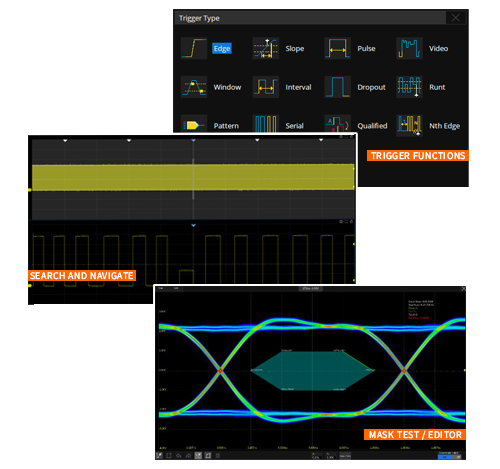
Intelligent trigger: Edge, Slope, Pulse, Window, Runt, Interval, Dropout, Pattern, Qualified, Nth edge, Setup/hold, Delay and Video (HDTV supported). Zone Trigger simplifies advanced triggering
Segmented acquisition (Sequence) mode, dividing the maximum record length into multiple segments (up to 124,000), according to trigger conditions set by the user, with a very small dead time between segments to capture the qualifying event
History waveform record (History) function, the maximum recorded waveform length is 124,000 frames
Automatic measurements on 50+ parameters, supports statistics with histogram, track, trend, Gating measurement, and measurements on Math, History and Memory traces
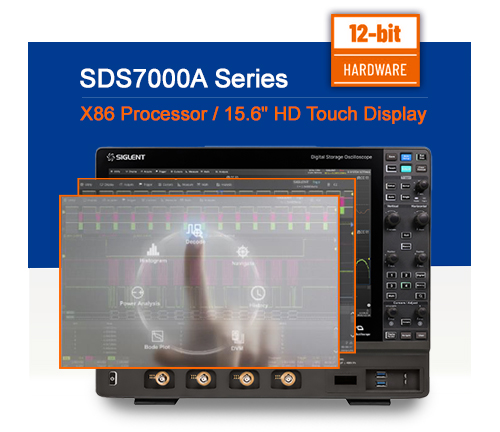
4 Math traces (32 Mpts FFT, Filter, addition, subtraction, multiplication, division, integration, differential, square root, etc.), supports formula editor
Abundant data analysis functions such as Search, Navigate, SignalScan, Digital Voltmeter, Counter, Waveform Histogram and Bode plot. Optional functions are Power Analysis, Eye/Jitter Analysis and Compliance Test.
Serial bus triggering and decoder, supports protocols I2C, SPI, UART, CAN, LIN as standard and optional protocols CAN FD, FlexRay, I2S, MIL-STD-1553B, SENT, ARINC429, Manchester and USB 2.0
Spectrum Analyzer mode (A models only)
High Speed hardware-based Average, Hi-Res; High Speed hardware-based Mask Test function, with Mask Editor tool for creating user-defined masks
16 digital channels (SPL2016 logic probe sold separately)
Large 15.6-inch HD TFT-LCD display with 1920 * 1080 resolution; Capacitive touch screen supports multi-touch gestures.
Interfaces include: 4x USB Host 3.1 Gen 1 2x USB 3.0 Host, USB 2.0 Device, 2x 1000M LAN, DVI-D, DP 1.2, HDMI 1.4, Audio, External Triger In, Aux Out (Pass/Fail, Trigger Out), 10 MHz In, 10 MHz Out
Built-in web server supports remote control over the LAN port using a web browser. Supports SCPI remote control commands. Supports external mouse and keyboard
Built-in 50 MHz waveform generator (option: SDS7000A-FG)
Upgraded Processor System
The Siglent SDS7000A series features a fully upgraded internal architecture with a new x86-based high-speed processor platform. This enhancement significantly boosts the oscilloscope’s system responsiveness, measurement speed, and data analysis performance presenting more possibilities for the expansion of software analysis functions in the future.
Restore the Signal Perfectly
With a high sampling rate of 20 GSa/s, the SDS7000A series of oscilloscopes minimize signal distortion for a more accurate waveform capture. Its deep memory—up to 1 Gpts per channel—allows for continuous recording of signal sequences lasting up to 50 milliseconds at the maximum sampling rate, without missing any data. Engineers can use built-in search, navigation, and history tools to efficiently analyze the entire captured waveform. Additionally, the 12-bit ADC ensures low quantization error, enabling precise waveform observation and measurement.
SDS7000A Series
The SIGLENT SDS7000A series includes six digital storage oscilloscope models with bandwidth options of 3, 4, 6, and 8 GHz. Each model features a 12-bit ADC, supports sampling rates up to 20 GSa/s, and offers a maximum record length of 2 Gpts per channel. They support up to 4 analog and 16 digital channels, making them ideal for high-performance mixed-signal analysis.
Vertical (analog) | SDS7804AP | SDS7604AP | SDS7404A H12 | SDS7304A H12 |
|---|---|---|---|---|
Channel | 4 + EXT | 4 + EXT | 4 + EXT | 4 + EXT |
Bandwidth (-3dB) at 50Ω | 8 GHz *1*2 | 6 GHz *1*2 | 4 GHz | 3 GHz |
*1:Enhanced Bandwidth = ON, and Type = Best Flatness | ||||
Acquire (analog) | A models | AP models | ||
Sample rate | 20 GSa/s (2 channels) *1 10 GSa/s (3 or 4 channels) | 20 GSa/s at all channels | ||
Memory depth *2*3 (See data sheet for full specs) | Standard: 500 Mpts/ch Optional: 1 Gpts/ch in dual-channel mode | Standard: 1 Gpts/ch (1 or 2 channels) 500 Mpts/ch (3 or 4 channels) Optional: 2 Gpts/ch (1 channel) 1 Gpts/ch (2 channels) 500 Mpts/ch (3 or 4 channels) | ||
*1:2 channels: C1/C2 are not both active, and C3/C4 are not both active | ||||
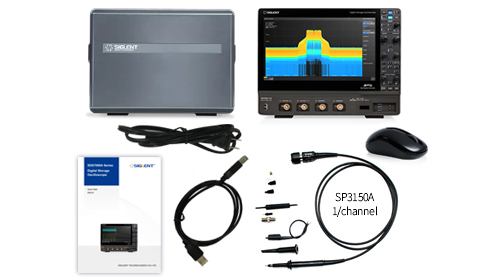
What's in the Box
SDS7804A H12 Oscilloscope
USB Cable
500 MHz Passive Probe, 1 for each channel
Certificate of Calibration (not shown)
Quick Start
Wireless Mouse
Power Cord
Protective Cover
Editable Heading
Does the Siglent SDS7804A H12 oscilloscope support 16 digital channels?
Yes, it does support 16 digital channels in addition to its 4 analog channels. It requires the use of the SPL2016 logic probe to access this feature. This makes it a mixed-signal oscilloscope (MSO), ideal for analyzing both analog and digital signals simultaneously in high-performance applications.What new functions are possible with the Siglent SDS7804A H12 oscilloscope?
The SDS7804A H12 oscilloscope introduces several powerful new functions that significantly expand its capabilities beyond traditional waveform capture like 2.5G/5G/10GBase-T Ethernet Electrical Compliance Testing, MIPI-DPHY Protocol Analysis, and Enhanced CAN XL Decoding.What exactly is Siglent’s SPO technology?
SPO, known as Super Phosphor Oscilloscope technology, is a proprietary waveform acquisition and display system designed to enhance signal visibility and analysis. It uses a high-speed FPGA-based engine to process and render waveforms, significantly reducing dead time between acquisitions. This allows for extremely high waveform capture rates making it easier to detect rare or intermittent signal anomalies. SPO also includes 256-level intensity grading and color temperature display.